Appendix G - Coding Agents
附录 G - 编码智能体
Vibe Coding: A Starting Point
Vibe 编码:入门路径
“Vibe coding” has become a powerful technique for rapid innovation and creative exploration. This practice involves using LLMs to generate initial drafts, outline complex logic, or build quick prototypes, significantly reducing initial friction. It is invaluable for overcoming the “blank page” problem, enabling developers to quickly transition from a vague concept to tangible, runnable code. Vibe coding is particularly effective when exploring unfamiliar APIs or testing novel architectural patterns, as it bypasses the immediate need for perfect implementation. The generated code often acts as a creative catalyst, providing a foundation for developers to critique, refactor, and expand upon. Its primary strength lies in its ability to accelerate the initial discovery and ideation phases of the software lifecycle. However, while vibe coding excels at brainstorming, developing robust, scalable, and maintainable software demands a more structured approach, shifting from pure generation to a collaborative partnership with specialized coding agents.
“Vibe 编码”已发展为快速创新与创意探索的高效技术。该实践通过运用 LLM 生成初始草稿、梳理复杂逻辑或构建快速原型,显著降低启动门槛。它能有效帮助开发者克服”空白页”困境,从模糊概念快速过渡到可运行的具体代码。在探索陌生 API 或测试新型架构模式时,Vibe 编码尤为高效,因为它无需一开始就追求完美实现。生成的代码往往作为创意催化剂,为开发者提供可批判、重构和扩展的基础。其核心优势在于加速软件生命周期中的初始探索与概念形成阶段。然而,尽管 Vibe 编码在头脑风暴方面表现出色,构建稳健、可扩展且可维护的软件仍需要更结构化的方法——从纯粹生成转向与专业化编码智能体的协作伙伴关系。
Agents as Team Members
智能体团队成员
While the initial wave focused on raw code generation—the “vibe code” perfect for ideation—the industry is now shifting towards a more integrated and powerful paradigm for production work. The most effective development teams are not merely delegating tasks to Agent; they are augmenting themselves with a suite of sophisticated coding agents. These agents act as tireless, specialized team members, amplifying human creativity and dramatically increasing a team’s scalability and velocity.
尽管初期浪潮聚焦于原始代码生成——适合概念构思的”vibe 代码”——但行业如今正转向更集成、更强大的生产工作范式。最高效的开发团队不仅将任务委托给智能体,更是通过整套复杂的编码智能体来增强自身能力。这些智能体充当不知疲倦的专业团队成员,放大人类创造力,并显著提升团队的可扩展性和开发速度。
This evolution is reflected in statements from industry leaders. In early 2025, Alphabet CEO Sundar Pichai noted that at Google, “over 30% of new code is now assisted or generated by our Gemini models, fundamentally changing our development velocity.” Microsoft made a similar claim. This industry-wide shift signals that the true frontier is not replacing developers, but empowering them. The goal is an augmented relationship where humans guide the architectural vision and creative problem-solving, while agents handle specialized, scalable tasks like testing, documentation, and review.
这一演进趋势体现在行业领袖的公开声明中。2025 年初,Alphabet CEO Sundar Pichai 指出,在 Google 内部,“超过 30% 的新代码现由 Gemini 模型辅助或生成,从根本上改变了我们的开发节奏。” Microsoft 也发表了类似声明。这一全行业转型表明,真正的前沿并非替代开发者,而是为其赋能。目标是建立一种增强型协作关系:人类主导架构愿景和创造性问题解决,而智能体处理专业化、可扩展的任务,如测试、文档编制和代码审查。
This chapter presents a framework for organizing a human-agent team based on the core philosophy that human developers act as creative leads and architects, while AI agents function as force multipliers. This framework rests upon three foundational principles:
本章提出一个人机协作团队的组织框架,其核心理念是:人类开发者担任创意领导和架构师,而 AI 智能体充当能力倍增器。该框架基于三大基本原则:
- Human-Led Orchestration: The developer is the team lead and project architect. They are always in the loop, orchestrating the workflow, setting the high-level goals, and making the final decisions. The agents are powerful, but they are supportive collaborators. The developer directs which agent to engage, provides the necessary context, and, most importantly, exercises the final judgment on any Agent-generated output, ensuring it aligns with the project’s quality standards and long-term vision.
- The Primacy of Context: An agent’s performance is entirely dependent on the quality and completeness of its context. A powerful LLM with poor context is useless. Therefore, our framework prioritizes a meticulous, human-led approach to context curation. Automated, black-box context retrieval is avoided. The developer is responsible for assembling the perfect “briefing” for their Agent team member. This includes:
- The Complete Codebase: Providing all relevant source code so the agent understands the existing patterns and logic.
- External Knowledge: Supplying specific documentation, API definitions, or design documents.
- The Human Brief: Articulating clear goals, requirements, pull request descriptions, and style guides.
-
Direct Model Access: To achieve state-of-the-art results, the agents must be powered by direct access to frontier models (e.g., Gemini 2.5 PRO, Claude Opus 4, OpenAI, DeepSeek, etc). Using less powerful models or routing requests through intermediary platforms that obscure or truncate context will degrade performance. The framework is built on creating the purest possible dialogue between the human lead and the raw capabilities of the underlying model, ensuring each agent operates at its peak potential.
- 人类主导的流程编排: 开发者是团队领导和项目架构师。他们始终处于决策闭环中,负责编排工作流、设定高层目标并做出最终决策。智能体虽然强大,但只是支持性协作者。开发者指导调用哪个智能体、提供必要的上下文,最重要的是——对智能体生成的任何输出行使最终裁决权,确保其符合项目的质量标准和长期愿景。
- 上下文的核心地位: 智能体的表现完全取决于其上下文的质量和完整性。一个强大的 LLM 如果缺乏优质上下文将毫无用处。因此,本框架优先采用人类主导的精细化上下文管理策略,避免自动化黑盒式上下文检索。开发者负责为智能体团队成员精心准备完美的”任务简报”,包括:
- 完整代码库: 提供所有相关源代码,使智能体理解现有的模式和逻辑结构。
- 外部知识: 补充特定文档、API 定义或设计规范。
- 人工任务简报: 明确阐述目标、需求、拉取请求描述和编码规范。
- 直接模型访问机制: 为实现尖端效果,智能体必须通过直接访问前沿模型(如 Gemini 2.5 PRO、Claude Opus 4、OpenAI、DeepSeek 等)来驱动。使用性能较弱的模型或经由会模糊或截断上下文的中介平台转发请求将降低性能。本框架致力于在人类领导与底层模型的原始能力之间建立最纯净的对话通道,确保每个智能体以峰值潜力运行。
The framework is structured as a team of specialized agents, each designed for a core function in the development lifecycle. The human developer acts as the central orchestrator, delegating tasks and integrating the results.
该框架构建为一个专业化智能体团队,每个智能体专为开发生命周期中的核心功能而设计。人类开发者担任中央编排者,负责任务委派和成果整合。
Core Components
核心组件
To effectively leverage a frontier Large Language Model, this framework assigns distinct development roles to a team of specialized agents. These agents are not separate applications but are conceptual personas invoked within the LLM through carefully crafted, role-specific prompts and contexts. This approach ensures that the model’s vast capabilities are precisely focused on the task at hand, from writing initial code to performing a nuanced, critical review.
为有效利用前沿大语言模型,本框架将不同的开发角色分配给专业化智能体团队。这些智能体不是独立的应用程序,而是通过精心设计的角色特定提示和上下文在 LLM 中调用的概念化人格。这种方法确保模型的强大能力精准聚焦于手头的任务——从编写初始代码到进行细致的批判性审查。
The Orchestrator: The Human Developer: In this collaborative framework, the human developer acts as the Orchestrator, serving as the central intelligence and ultimate authority over the AI agents.
流程编排者:人类开发者: 在此协作框架中,人类开发者担任编排者,作为 AI 智能体的中央智能节点和最终权威。
- Role: Team Lead, Architect, and final decision-maker. The orchestrator defines tasks, prepares the context, and validates all work done by the agents.
- Interface: The developer’s own terminal, editor, and the native web UI of the chosen Agents.
- 角色定位: 团队领导、架构师和最终决策者。编排者负责定义任务、准备上下文,并验证智能体完成的所有工作。
- 交互界面: 开发者自己的终端、编辑器,以及所选智能体的原生 Web 界面。
The Context Staging Area: As the foundation for any successful agent interaction, the Context Staging Area is where the human developer meticulously prepares a complete and task-specific briefing.
上下文准备区: 作为任何成功智能体交互的基础,上下文准备区是人类开发者精心准备完整且任务特定简报的专用空间。
- Role: A dedicated workspace for each task, ensuring agents receive a complete and accurate briefing.
- Implementation: A temporary directory (task-context/) containing markdown files for goals, code files, and relevant docs
- 功能定位: 为每项任务提供独立工作环境,确保智能体获得完整准确的简报材料。
- 技术实现: 临时目录(task-context/)包含目标说明的 markdown 文件、相关代码文件及配套文档。
The Specialist Agents: By using targeted prompts, we can build a team of specialist agents, each tailored for a specific development task.
专业化智能体: 通过使用定向提示,我们可以构建一个专业化智能体团队,每个成员针对特定开发任务量身定制。
- The Scaffolder Agent: The Implementer
- Purpose: Writes new code, implements features, or creates boilerplate based on detailed specifications.
- Invocation Prompt: “You are a senior software engineer. Based on the requirements in 01_BRIEF.md and the existing patterns in 02_CODE/, implement the feature…”
- 脚手架智能体:代码实施专家
- 核心职能: 依据详细规范编写新代码、实现功能特性或创建基础模板。
- 调用提示模板:
1
你是一名资深软件工程师。请基于 01_BRIEF.md 中的需求说明与 02_CODE/ 目录下的现有模式,实现指定功能...
- The Test Engineer Agent: The Quality Guard
- Purpose: Writes comprehensive unit tests, integration tests, and end-to-end tests for new or existing code.
- Invocation Prompt: “You are a quality assurance engineer. For the code provided in 02_CODE/, write a full suite of unit tests using [Testing Framework, e.g., pytest]. Cover all edge cases and adhere to the project’s testing philosophy.”
- 测试工程师智能体:质量守护者
- 核心职能: 为新代码或现有代码编写全面的单元测试、集成测试及端到端测试套件。
- 调用提示模板:
1
你是一名质量保证工程师。针对 02_CODE/ 中提供的代码,使用 [测试框架,如 pytest] 编写完整单元测试套件。需覆盖所有边界情况并遵循项目测试规范。
- The Documenter Agent: The Scribe
- Purpose: Generates clear, concise documentation for functions, classes, APIs, or entire codebases.
- Invocation Prompt: “You are a technical writer. Generate markdown documentation for the API endpoints defined in the provided code. Include request/response examples and explain each parameter.”
- 文档编写智能体:技术文档专员
- 核心职能: 为函数、类、API 或完整代码库生成清晰、简洁的技术文档。
- 调用提示模板:
1
你是一名技术文档工程师。为指定代码中定义的 API 端点生成 markdown 格式文档。需包含请求/响应示例并对各参数进行详细说明。
- The Optimizer Agent: The Refactoring Partner
- Purpose: Proposes performance optimizations and code refactoring to improve readability, maintainability, and efficiency.
- Invocation Prompt: “Analyze the provided code for performance bottlenecks or areas that could be refactored for clarity. Propose specific changes with explanations for why they are an improvement.”
- 优化智能体:代码重构顾问
- 核心职能: 提出性能优化方案与代码重构建议,以提升可读性、可维护性及执行效率。
- 调用提示模板:
1
分析提供代码中的性能瓶颈与可重构区域。提出具体改进方案并阐述各项更改的优化价值。
- The Process Agent: The Code Supervisor
- Critique: The agent performs an initial pass, identifying potential bugs, style violations, and logical flaws, much like a static analysis tool.
- Reflection: The agent then analyzes its own critique. It synthesizes the findings, prioritizes the most critical issues, dismisses pedantic or low-impact suggestions, and provides a high-level, actionable summary for the human developer.
- Invocation Prompt: “You are a principal engineer conducting a code review. First, perform a detailed critique of the changes. Second, reflect on your critique to provide a concise, prioritized summary of the most important feedback.”
- 流程智能体:代码质量监督员
- 批判分析: 智能体执行初步审查,识别潜在缺陷、编码规范违规及逻辑漏洞,功能类似静态分析工具。
- 深度反思: 智能体对自身批判进行元分析。综合各项发现,优先处理关键问题,过滤琐碎或低价值建议,为人类开发者提供高层级、可执行的总结报告。
- 调用提示模板:
1
你是一名首席工程师执行代码审查。首先对变更进行详细批判分析,随后进行反思总结,提供关键反馈的优先级排序摘要。
Ultimately, this human-led model creates a powerful synergy between the developer’s strategic direction and the agents’ tactical execution. As a result, developers can transcend routine tasks, focusing their expertise on the creative and architectural challenges that deliver the most value.
最终,这种人类主导的模式在开发者的战略方向与智能体的战术执行之间建立了强大的协同效应。因此,开发者可以超越常规任务,将专业知识聚焦于创造最大价值的创意和架构挑战上。
Practical Implementation
实践实施
Setup Checklist
配置清单
To effectively implement the human-agent team framework, the following setup is recommended, focusing on maintaining control while improving efficiency.
为有效实施人机协作团队框架,建议采用以下配置,核心目标是在提升效率的同时保持完全控制。
- Provision Access to Frontier Models Secure API keys for at least two leading large language models, such as Gemini 2.5 Pro and Claude 4 Opus. This dual-provider approach allows for comparative analysis and hedges against single-platform limitations or downtime. These credentials should be managed securely as you would any other production secret.
- Implement a Local Context Orchestrator Instead of ad-hoc scripts, use a lightweight CLI tool or a local agent runner to manage context. These tools should allow you to define a simple configuration file (e.g., context.toml) in your project root that specifies which files, directories, or even URLs to compile into a single payload for the LLM prompt. This ensures you retain full, transparent control over what the model sees on every request.
- Establish a Version-Controlled Prompt Library Create a dedicated /prompts directory within your project’s Git repository. In it, store the invocation prompts for each specialist agent (e.g., reviewer.md, documenter.md, tester.md) as markdown files. Treating your prompts as code allows the entire team to collaborate on, refine, and version the instructions given to your AI agents over time.
-
Integrate Agent Workflows with Git Hooks Automate your review rhythm by using local Git hooks. For instance, a pre-commit hook can be configured to automatically trigger the Reviewer Agent on your staged changes. The agent’s critique-and-reflection summary can be presented directly in your terminal, providing immediate feedback before you finalize the commit and baking the quality assurance step directly into your development process.
- 前沿模型访问权限配置 获取至少两个领先大语言模型(如 Gemini 2.5 Pro 与 Claude 4 Opus)的 API 访问密钥。这种双供应商策略便于性能对比分析,同时规避单一平台限制或服务中断风险。此类凭证应按照生产环境密钥管理规范进行安全存储。
- 本地上下文编排器部署 采用轻量级 CLI 工具或本地智能体运行器来管理上下文,而非临时脚本方案。此类工具应支持在项目根目录定义简明配置文件(如 context.toml),明确指定需编译至 LLM 提示词统一载荷的文件、目录或 URL 资源。这确保您对模型每次请求所见内容保持完全透明的控制。
- 版本化提示词库构建 在项目 Git 仓库内创建专用 /prompts 目录。以 markdown 文件形式存储各专业智能体的调用提示词(如 reviewer.md、documenter.md、tester.md)。将提示词视同代码资产管理,支持团队持续协作优化、版本追踪及 AI 智能体的迭代演进。
- 智能体工作流与 Git 钩子集成 通过本地 Git 钩子实现审查流程自动化。例如,配置 pre-commit 钩子自动在暂存变更上触发审查者智能体。智能体生成的批判与反思摘要将直接输出至终端,在提交确认前提供即时质量反馈,将质量保障环节深度嵌入开发流程。
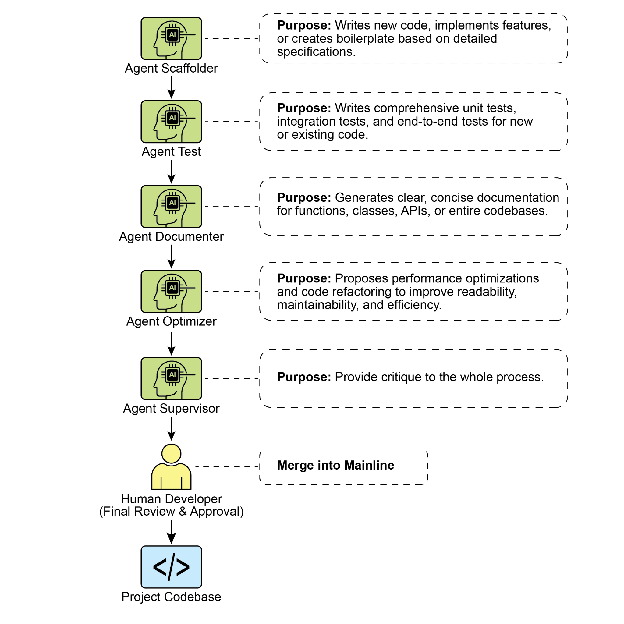
Fig. 1: Coding Specialist Examples
图 1:编码专家角色示例
Principles for Leading the Augmented Team
增强型团队领导原则
Successfully leading this framework requires evolving from a sole contributor into the lead of a human-AI team, guided by the following principles:
成功驾驭此框架需要实现从独立贡献者向人机协作团队领导者的角色转型,遵循以下核心原则:
- Maintain Architectural Ownership Your role is to set the strategic direction and own the high-level architecture. You define the “what” and the “why,” using the agent team to accelerate the “how.” You are the final arbiter of design, ensuring every component aligns with the project’s long-term vision and quality standards.
- Master the Art of the Brief The quality of an agent’s output is a direct reflection of the quality of its input. Master the art of the brief by providing clear, unambiguous, and comprehensive context for every task. Think of your prompt not as a simple command, but as a complete briefing package for a new, highly capable team member.
- Act as the Ultimate Quality Gate An agent’s output is always a proposal, never a command. Treat the Reviewer Agent’s feedback as a powerful signal, but you are the ultimate quality gate. Apply your domain expertise and project-specific knowledge to validate, challenge, and approve all changes, acting as the final guardian of the codebase’s integrity.
-
Engage in Iterative Dialogue The best results emerge from conversation, not monologue. If an agent’s initial output is imperfect, don’t discard it—refine it. Provide corrective feedback, add clarifying context, and prompt for another attempt. This iterative dialogue is crucial, especially with the Reviewer Agent, whose “Reflection” output is designed to be the start of a collaborative discussion, not just a final report.
- 坚守架构主导权 您的核心职责是制定战略方向并掌控高层架构设计。您定义”目标”和”设计理念”,借助智能体团队加速”实施方案”落地。作为设计决策的最终仲裁者,确保各组件严格遵循项目长期愿景与质量标准。
- 精研任务简报技艺 智能体的输出质量直接映射输入信息质量。通过为每项任务提供清晰无歧义、内容完备的上下文掌握简报艺术。应将提示词视为面向高能力新团队成员的完整任务简报包,而非简单指令。
- 担当终极质量关口 智能体的输出始终属于建议方案,绝非强制命令。将审查者智能体的输出作为重要参考信号,但您承担最终质量决策责任。运用领域专业知识与项目特定认知验证、质询并核准所有变更,担当代码库完整性的终极守护者。
- 践行迭代对话模式 最优成果源于双向对话而非单向指令。若智能体输出存在不足,应导向完善而非弃用。提供修正反馈、补充澄清上下文、引导二次尝试。此迭代对话机制至关重要,尤其针对审查者智能体——其”反思”输出设计为协作讨论起点,而非终态报告。
Conclusion
结论
The future of code development has arrived, and it is augmented. The era of the lone coder has given way to a new paradigm where developers lead teams of specialized AI agents. This model doesn’t diminish the human role; it elevates it by automating routine tasks, scaling individual impact, and achieving a development velocity previously unimaginable.
代码开发的未来图景已然呈现——它是增强协同的崭新范式。独行编码者的时代正演进为开发者引领专业化 AI 智能体的新纪元。这种模式非但没有削弱人类角色,反而通过自动化常规任务、放大个体影响力以及实现前所未有的开发效能将其提升至新高度。
By offloading tactical execution to Agents, developers can now dedicate their cognitive energy to what truly matters: strategic innovation, resilient architectural design, and the creative problem-solving required to build products that delight users. The fundamental relationship has been redefined; it is no longer a contest of human versus machine, but a partnership between human ingenuity and AI, working as a single, seamlessly integrated team.
通过将战术执行委派予智能体,开发者得以将认知资源聚焦于真正核心的领域:战略创新、韧性架构设计,以及打造令用户惊喜的产品所需的创造性问题破解。根本性协作关系已被重新定义:这不再是人与机器的对抗竞赛,而是人类智慧与人工智能作为无缝集成团队的深度伙伴关系。
References
参考文献
- AI is responsible for generating more than 30% of the code at Google https://www.reddit.com/r/singularity/comments/1k7rxo0/ai_is_now_writing_well_over_30_of_the_code_at/
- AI is responsible for generating more than 30% of the code at Microsoft https://www.businesstoday.in/tech-today/news/story/30-of-microsofts-code-is-now-ai-generated-says-ceo-satya-nadella-474167-2025-04-30